


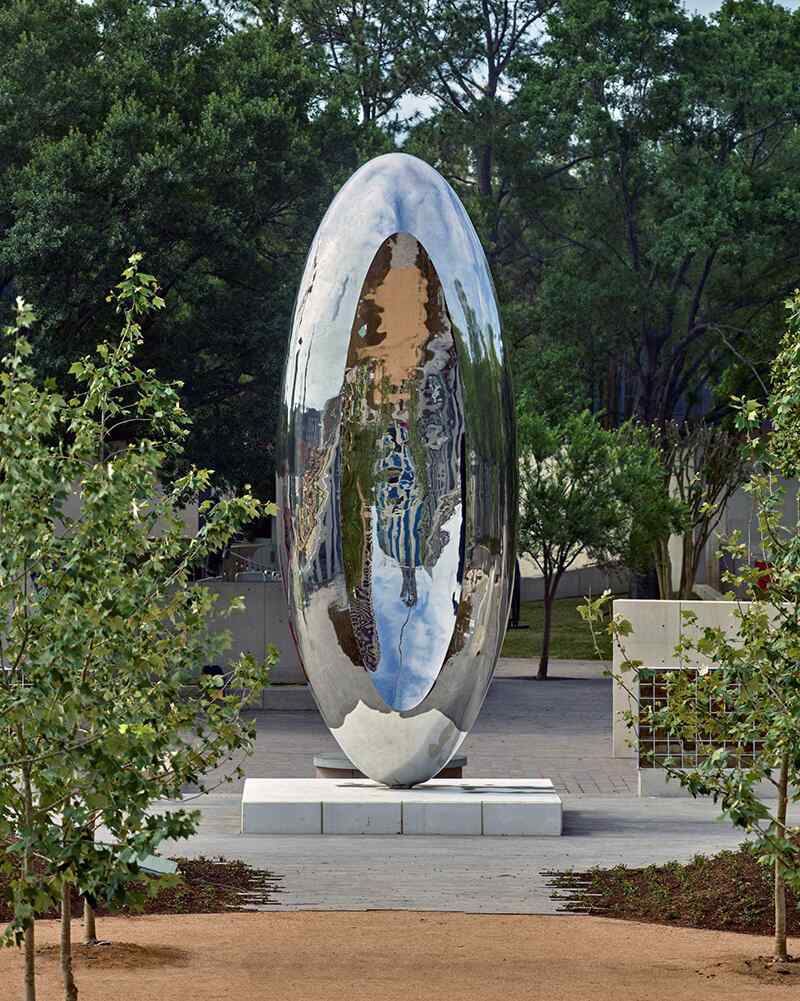
Aluminium has a reputation for being easy to polish. It’s soft, light, and shapes without much argument. That reputation is misleading.
Aluminium is one of the trickier metals to bring to a proper mirror finish. If you’re specifying it for a sculpture, an architectural feature, or a restoration where the finish will be looked at closely, the reasons matter.
Most of what’s written online about aluminium polishers UK comes from aluminium suppliers who offer polishing as an add-on to selling material. That service works well for standard extrusions and sheet stock. Specialist workshop polishing is a different job, and it produces a different result.
This article walks through why aluminium behaves the way it does under the wheel, how alloy type changes what’s achievable, the finish grades we work to, and when a specialist workshop is the right choice over a supplier’s polishing line. If you’ve got a sculpture, an architectural piece, or a restoration coming up in aluminium, this should help you brief it properly.
Why aluminium is deceptively difficult
Aluminium behaves differently from stainless steel under the wheel. Stainless fractures at a microscopic level as the abrasive passes over it. Aluminium smears. The material is ductile enough that it flows sideways instead of being cut cleanly away. A surface can look glossy after polishing and still carry subsurface roughness that only shows up later, often after anodising or under strong side lighting.
Then there’s oxidation. Aluminium forms an oxide layer within seconds of being exposed to air. Every stage of polishing removes that layer and lets a new one form immediately behind it.
Aggressive pressure doesn’t speed anything up. It heats the surface, disrupts the oxide unevenly, and produces a worse result than a lighter touch. A workshop that handles aluminium the way it handles stainless steel will produce a finish that looks acceptable at first glance and disappoints under proper lighting.
Alloy type changes everything
Aluminium is a family of alloys, not a single material. The alloy you’re working with dictates what’s achievable.
Wrought alloys in the 5000 and 6000 series are the most common in architectural and structural work. They polish predictably and take a bright finish well.
Cast aluminium is different. Cast alloys contain silicon and often have porosity in the surface. You can bring cast aluminium to a strong shine, and we have taken cast pieces to a genuine mirror where the casting quality allowed it, but it’s not something to assume at the specification stage. The internal structure of the material has to cooperate. Sculptors working with cast pieces should have that conversation with the workshop before the finish is written into the spec.
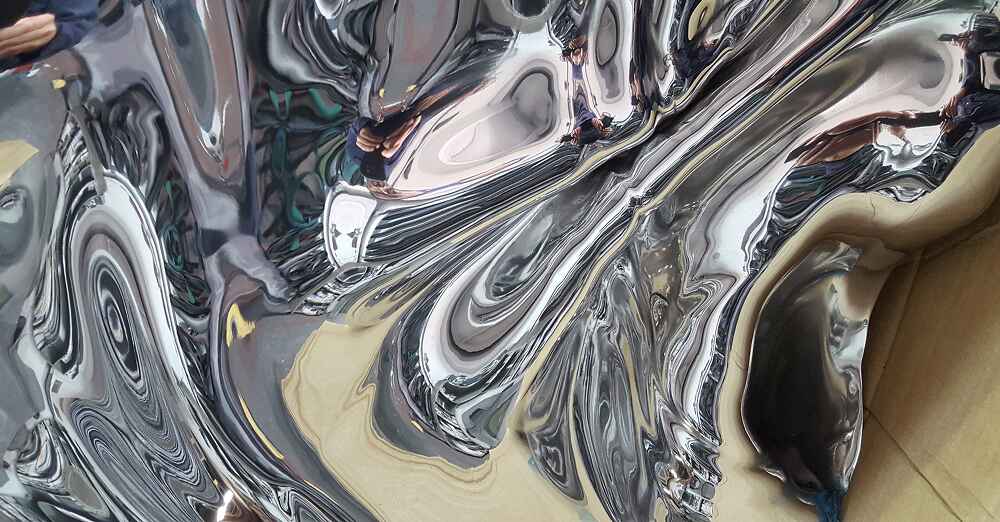 Cast aluminium finished to mirror in the HGMP workshop. Achievable where the casting quality allows, though not to be assumed at the specification stage
The softer 1000-series alloys polish easily but scratch just as easily. Anything shipped or handled after polishing needs proper protection, and any contact with the surface has to be planned for.
Before we quote an aluminium job we want to understand what we’re dealing with. That usually means a conversation about the alloy grade if the client knows it, the form of the material (cast, extruded, sheet, fabricated), and where the finished piece is going. Those three answers change the process from start to finish, and the conversation matters more than a form to fill in.
Finish grades in aluminium polishing services
We work to the same named grades on aluminium as on stainless: Orbital Sand, Satin, Bright, Mirror and Superior Mirror. What each grade looks like in aluminium differs slightly from stainless, because the underlying material reflects light differently.
Satin and Bright
Satin and Bright are the workhorses for architectural aluminium: window sections, cladding features, handrails, interior fittings. They read as clean and uniform, and they hold up under normal wear.
Mirror and Superior Mirror
Mirror and Superior Mirror on aluminium are specified for sculpture, feature panels and display work where reflectivity is the point. They take longer to produce on aluminium than on stainless because of the smearing behaviour. Skipping stages in the grit sequence, which some workshops do to save time, always shows up in the final finish.
Orbital Sand
Orbital Sand on aluminium gives a directional pattern that suits certain architectural applications, particularly where a warmer, less clinical look is wanted than a satin stainless equivalent.
What specialist aluminium polishing does differently
Aluminium suppliers’ polishing lines are set up for volume. Sheet in, sheet out, consistent grade, predictable output. For a run of standard extrusions to a satin finish, that’s the right tool.
Specialist workshop polishing is what happens when the job doesn’t fit that model:
- A sculpture with compound curves
- A restored architectural feature that needs to match adjacent original work
- A one-off where the client has supplied the material and the geometry is bespoke
- A piece where the finish grade is Mirror or Superior Mirror and will be seen at close range
Most of the difference is handwork. Complex geometries need to be worked by hand, section by section, with the operator judging the transition between areas. A flatbed line isn’t built for that. Handwork is also how mistakes get caught before they become defects. A skilled polisher sees a scratch or a smeared area developing and adjusts before it’s baked in.
We also work regularly with free-issue material, meaning the client supplies the aluminium and we finish it. That flexibility matters when fabrication has been done elsewhere or when a piece is being restored rather than made new.
Protecting the finish
A freshly polished aluminium surface is chemically reactive. The oxide layer will re-form within seconds, but in ambient conditions that new layer isn’t uniform, and it can dull the finish over weeks and months. Fingerprints etch. Coastal air pits the surface. Rain leaves marks.
The three options are:
Lacquering
Lacquering gives an immediate protective coat. It has a finite lifespan and can yellow over time, so it suits interior pieces and short-to-medium term protection rather than long outdoor exposure. We don’t lacquer in-house, but we work with trusted partners and can arrange this as part of the job or refer you directly, depending on what suits the project.
Anodising after polishing
Anodising builds a controlled oxide layer over the polished surface. It’s durable and long-lasting, but it slightly softens the highest gloss finishes. For most architectural applications that trade-off is fine. For pure display sculpture where reflectivity is the point, it may not be. Anodising is also referred out to specialist partners. We’ll advise on who to use and how it coordinates with the polishing stage.
Ongoing maintenance
The third option is doing nothing at the point of finishing and maintaining the piece through periodic re-polishing. That suits interior sculpture that isn’t being handled. It doesn’t work for almost anything outside.
Where the piece is going and what the client will maintain determines the right answer. That’s a conversation to have before the job starts, not after.
When to bring aluminium to specialist metal polishers
If the job is a run of standard extrusions to a satin finish, an aluminium supplier’s polishing line will handle it well, and probably cheaper than we can.
If the job is any of the following, that’s when a specialist workshop earns its place:
- A sculpture or piece of artwork
- An architectural feature or restoration
- A one-off with geometry that doesn’t sit flat on a bed
- A Mirror or Superior Mirror finish
- Aluminium that will be viewed at close range in a public setting
For these jobs, the choice of workshop shapes the finished result more than most people realise.
How to brief an aluminium polishing job
If you’re specifying aluminium for an upcoming project, a short conversation before commitment saves time later. Bring what you know: the alloy grade if you have it, the form of the material, the intended finish, the location of the finished piece, and any maintenance expectations you’ve set with the end client.
If you’d like to talk through a piece, get in touch. Call us on +44 (0)20 8593 7314 or email info@highgradepolishers.co.uk.