


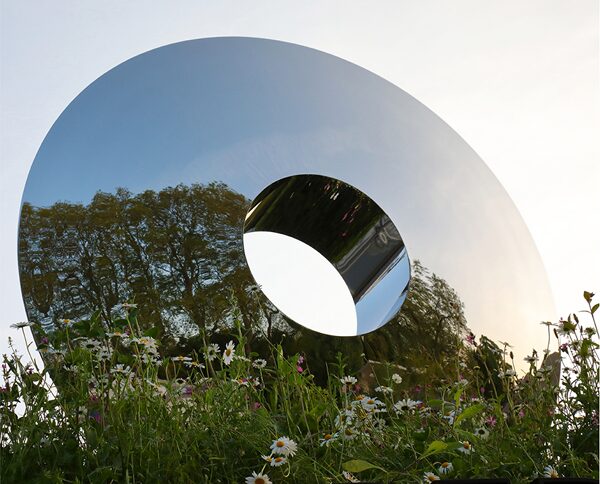
 Most artists spend months, sometimes years, designing and fabricating a sculpture. The finish, the polishing, which is what every viewer actually sees, is sometimes treated as an afterthought. It gets left to the final weeks of a commission, when timelines are tight and budgets are already stretched.
That is one of the most common mistakes we see, and it is one we help artists avoid.
At High Grade Metal Polishers, we work with sculptors and artists on large-scale metal commissions at every stage of the process, from early consultation through to final quality checks. Our role is not just to polish metal. It is to make sure the surface of your artwork does exactly what you intended, and keeps doing it for years after installation.
This article explains how that process works, what we need from you, and how to get the best result from the collaboration.
Why the Finish Matters More Than Most Artists Realise
Scale changes everything. A small inconsistency in surface texture that is invisible on a 30cm maquette becomes immediately apparent on a 3-metre sculpture. Weld marks, directional scratches, and variations in reflectivity all read differently at size, and under different light conditions.
The finish also determines how your work interacts with its environment. A mirror polish will reflect the surroundings and change appearance hour by hour. A satin finish will hold a consistent tone. An orbital sand finish will diffuse light softly. None of these is better than the others in isolation. The right choice depends on the artwork, the installation context, and what you are trying to achieve.
Beyond aesthetics, the finish protects the metal. A well-executed polish seals the surface, reduces the risk of corrosion, and extends the operational life of a piece, which matters particularly for outdoor public art commissions.
What We Need From You Before We Start
The more clearly you can brief us, the better the outcome. You do not need to know the technical terminology. You do need to think through a few things before we speak.
A Clear Description of the Visual Effect You Are After
“Mirror finish” is a good starting point. Beyond that, we will want to understand:
- What feeling or visual quality are you trying to create?
- Will the piece be indoors or outdoors?
- What is the primary light source, natural, artificial, or both?
- What is the likely viewing distance?
If you have reference images, bring them. They are often more useful than technical descriptions.
Material and Fabrication Details
The metal type affects what is possible. Stainless steel, aluminium, brass, and bronze each behave differently under polishing. We also need to know:
- The grade and thickness of the metal
- The quality of any welds, and how much preparation has been done
- The current surface condition
If fabrication is still in progress, now is the right time to talk to us. Surface preparation is far easier to plan when it is designed into the fabrication process from the start.
Scale and Logistics
Large pieces require logistical planning. We need to know the dimensions, weight, and how the piece is constructed. Some work is done in our workshop in Dagenham. Some commissions require us to work on-site. Understanding this early avoids delays later.
The Consultation and Quoting Process
We start with a conversation. For most large-scale commissions, that will involve a visit to our workshop, your studio, or the fabrication site, depending on where the work is at that stage.
We will ask questions, look at the piece or the drawings, and give you an honest assessment of what the finishing process will involve.
For complex or technically demanding commissions, we recommend test pieces before committing to the full project. A test piece on a section of the actual material lets us confirm the finish, agree on the result with the artist, and flag any issues with surface preparation before we are working on the final sculpture. It adds a small amount of time and cost upfront, and saves considerably more of both later.
Quoting is based on several factors: the total surface area to be finished, the finish grade selected, the amount of preparation required, and the logistics involved. We will always explain what is driving the cost.
How We Approach Large-Scale Work
Surface Preparation
Preparation is typically the most labour-intensive part of any large commission, and it is where the quality of the final finish is determined. Weld grinding, scratch removal, and working through progressive grits to achieve a consistent base are all part of this stage.
The quality of the fabrication affects how much preparation is needed. Poor welds, heavy grinding marks, or inconsistent surface texture will all need to be addressed before finishing can begin. We will always advise on what is needed and why.
Finish Application and Consistency
Maintaining consistency across a large surface is one of the core technical challenges of this work. We approach large pieces by dividing the surface into zones and working methodically, checking against a reference as we go.
Our five finish grades, Orbital Sand, Satin, Bright, Mirror, and Superior Mirror, each require a different process and a different level of preparation. The finish grade you choose will be agreed before work begins, and we will produce a sample or test piece so you can confirm it matches your intention before we proceed.
Quality Checks
We check at each stage, not just at the end. For complex commissions, we will agree sign-off points so you can see progress and confirm the result before we move on.
Working on Site vs in Our Workshop
Most finishing work is done in our Dagenham workshop, where we have the space, equipment, and controlled environment to work to a high standard. For pieces that can be transported, this is usually the preferred approach.
Some commissions require on-site finishing. Installed architectural features, very large sculptures, or work in sensitive locations may need us to come to the piece rather than the piece coming to us. We have experience working on site and will plan access and logistics accordingly.
For very large sculptures, it is sometimes necessary to finish sections in the workshop and complete final finishing after installation. We will advise on the best approach for your specific commission.
A Real Commission: ICON, a Tribute to Concorde
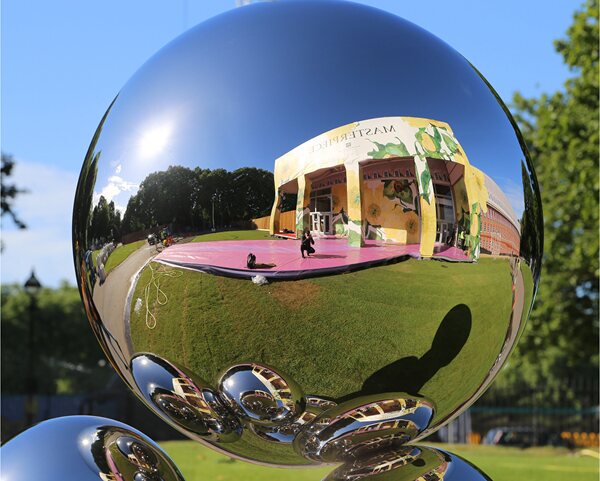
ICON is a seven-metre sculptural tribute to Concorde, built around the original nose assembly from the sixth Concorde airframe, a component used as a fatigue test specimen at the Royal Aircraft Establishment in Farnborough. It was commissioned by a private client and designed by Sebastian Conran Associates, with the concept drawn from the sonic waves Concorde generated travelling at Mach II.
The sculpture is built on a Weldox steel skeleton, skinned with three tonnes of polished stainless steel, and fitted with a rotational mechanism so it can be positioned pointing in any direction.
Our role was finishing the stand. It had to match the quality of the polished stainless steel cladding on the sculpture itself, on geometry that required precision hand work throughout. The upper surfaces were taken to superior mirror standard. The underside was given a contrasting sandblasted finish, a deliberate design choice that adds visual depth and reinforces the sculpture’s conceptual language around speed and aerodynamics.
Both finishes had to be executed to the same level of care. The boundary between them had to be clean and intentional.
You can read the full project breakdown in our ICON case study.
Starting Your Commission the Right Way
The artists we work with most successfully are the ones who contact us early. Not because the process is complicated, but because early conversation means the finish is designed into the project rather than bolted on at the end.
If you have a large-scale metal commission in progress or in planning, we are happy to have an initial conversation at no cost. Tell us about the project, where it is at, and what you are trying to achieve. We will give you an honest view of what is involved and how we can help.
Get in touch to start the conversation.
Common Questions From Artists
What finish grades do you offer?
We offer five grades: Orbital Sand, Satin, Bright, Mirror, and Superior Mirror. Each produces a different visual quality. We will help you identify which is right for your project based on your brief and the material you are working with.
Do you work on-site or only in your workshop?
Both. Most work is done in our Dagenham workshop, but we can work on-site where that is the better option for the commission.
How early in my project should I contact you?
As early as possible. Ideally before fabrication is complete. The finish specification can and should influence how the piece is fabricated, particularly around welds and surface preparation.
Can you work with materials other than stainless steel?
Yes. We work with stainless steel, aluminium, brass, bronze, and other metals. The approach varies by material. We will advise accordingly.
What if I am not sure how to describe the finish I want?
That is fine. Bring reference images, describe the feeling you are after, or tell us about the installation context. We will ask the right questions and help you identify the appropriate finish grade.